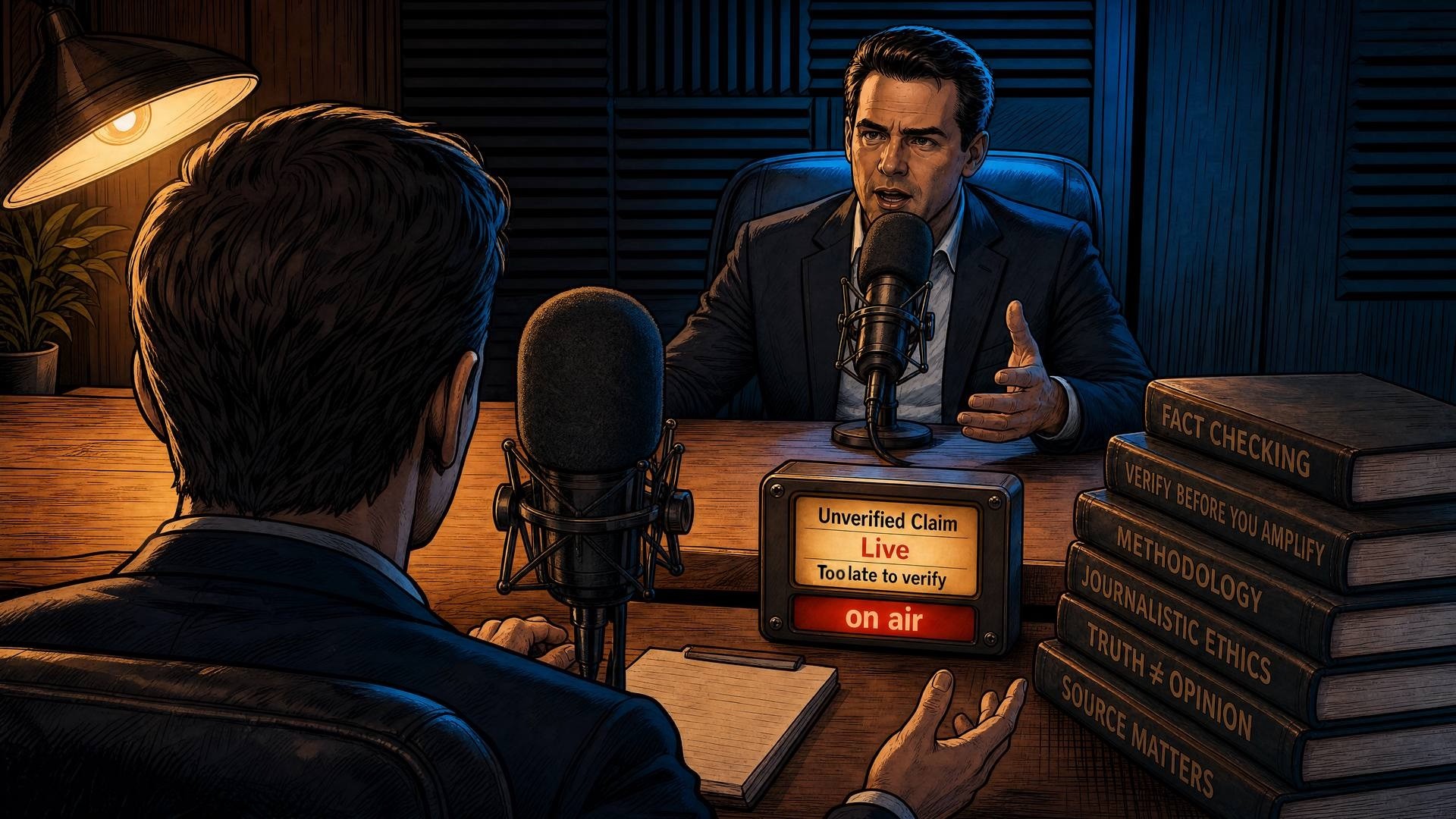
I don't think anyone can really fact-check a guest while they're talking. With AI it could run simultaneously, but it would be pretty distracting. What you can still check is what goes out afterwards, the episode, the clips and the notes. On a show's interview episode in October a guest said half of US women have dense breast tissue, the host repeated it as fact a few minutes later, and the episode's notes name no source for it. The actual US National Cancer Institute's figure is close to it, nearly half, but of women 40 and older who get mammograms. And after the BBC found guest health claims going through with little or no challenge on The Diary of a CEO, the show now says it checks its health episodes before they're published and takes claims it finds to be incorrect out of the audio.
I've never had a guest on a podcast myself. My own show runs on the same sourcing and research I sell, on all the topics it talks about, but it's presented by two AI-voiced hosts, no secret about that. So nothing guest-related in here comes from my own recordings. It comes from other people's interview episodes I went through for my research, and from what's public about one of the biggest interview shows there is.
Can you fact-check a podcast guest while they're talking?
No, and I don't think anyone really can. A solo episode can be checked before you record, as long as what you're going to say is written down somewhere first. An interview mostly has no script for the guest's part, so there's nothing to check ahead of time for what the guest will say, the claim just arrives live, in someone else's mouth, and you've got a few seconds to decide whether you push back or let it go.
So what does that look like on a real episode?
In October, on an oncology interview show, the guest was someone who co-founded a company that built software for breast MRI. At one point he says half of the women in the United States have dense breast tissue, and that in those women mammography misses 40% of breast cancers, and the only source he gives is "It's in the literature". A few minutes later the host puts the same number back to him as a plain fact, 50% of women in the US.
The actual US National Cancer Institute's figure is close to it, nearly half of all women who are 40 and older and get mammograms are found to have dense breast tissue, but in the episode it's about women in the US as a whole. And the episode's notes name no source for it, or for any other number in that episode, so a listener has nothing on the page to check it against.
What did the BBC find on The Diary of a CEO?
In December 2024 BBC World Service fact-checked, together with four medical experts, the 15 health episodes of The Diary of a CEO released between April and November that year that had potentially harmful claims in them, and found on average 14 harmful health claims in each, claims that went against extensive scientific evidence. According to the BBC those claims came from guests, and the host let them through with little or no challenge. I've written about that investigation before, in why health podcast misinformation is getting worse, so I won't go through it again.
After that, the show's executive producer told Business Insider in October 2026 that they raised their accuracy standards after the BBC investigation, and that an independent PhD researcher had fact-checked 71 episodes by then. The show's own page says every health and wellness episode is reviewed by that researcher before it's published. On audio, any claim they find to be incorrect is taken out before publication, so listeners never hear it, and on video a contested point gets a note on screen right where it's said. That's the show describing itself, and I did not check how well it works. But a show that, by its own page, has interviewed more than 600 people, a lot of them scientists, doctors and researchers, now checks its health episodes after the recording and before they go out, and puts it like this: "even the best experts are human".
Why can't you just correct it in the next episode?
You can, and you should, but a correction later on probably does less than you'd hope. A 2019 meta-analysis of 32 studies by Walter and Tukachinsky found that on average a correction doesn't entirely remove the effect of the misinformation. And corrections worked less well when the claim came from a credible source, when it had been repeated before the correction, and when time had passed in between. There's a newer study I wrote about in more detail on LinkedIn, where people listened to made-up radio news in a driving simulator, and while they were also doing little sums on a tablet, one correction didn't change anything you could measure, and three did.
Those are experiments, not podcasts, so what follows is my reading. A guest introduced as an expert is a credible source, a clip repeats what he said, and a correction episode comes weeks later, so an expert guest's claim can hit all three. The same analysis also found corrections work better when they come from the source of the misinformation itself, and for a podcast I'd say that's the show it went out on, as early as possible.
So where's the window, then?
Between the recording and the moment it goes out. What's said is said, of course, but at that point nothing has been clipped yet and the notes aren't out yet, so that's where a sentence with no source behind it can still be cut, put in context, or get its source in the notes.
And what about podcast guest vetting?
When I looked up how Google describes podcast guest vetting last time in November, the summary at the top was about fit: how the guest comes across on other shows, a pre-interview call, whether their topic suits your audience, their credentials, and a tech check. That all matters, of course, but I didn't see anything in there about checking the numbers a guest brings along.
This is what I sell, so here it is in plain sight
You know by now I'm not neutral here, I sell this. For interview episodes it runs on both sides of the recording. Before you record, you get research on the guest, so you know where to ask for a source while the mic is still on. After you record, I tell you which sentences have nothing behind them, while you still have time to do something about it before anything goes out.
The Diary of a CEO says it now has a medical PhD researcher checking its health episodes. On your show that check is my job, and the details are on my services page.
I've never had a guest myself, so I have no catch from my own recordings. I went looking for a study that counted how often guests on health shows say things that can't be sourced, and I didn't find one. The closest I found is a 2023 Brookings analysis of 79 popular political podcasts, where one in 20 episodes shared at least one unsubstantiated or false claim, but it doesn't count guests separately from hosts, and political shows aren't health shows. The research on corrections comes from experiments, not from podcasts, so putting it onto guests is my reading. What The Diary of a CEO does now is how the show describes itself, and I can't tell you how well it works. And nothing here is legal advice on who's responsible for what a guest says.