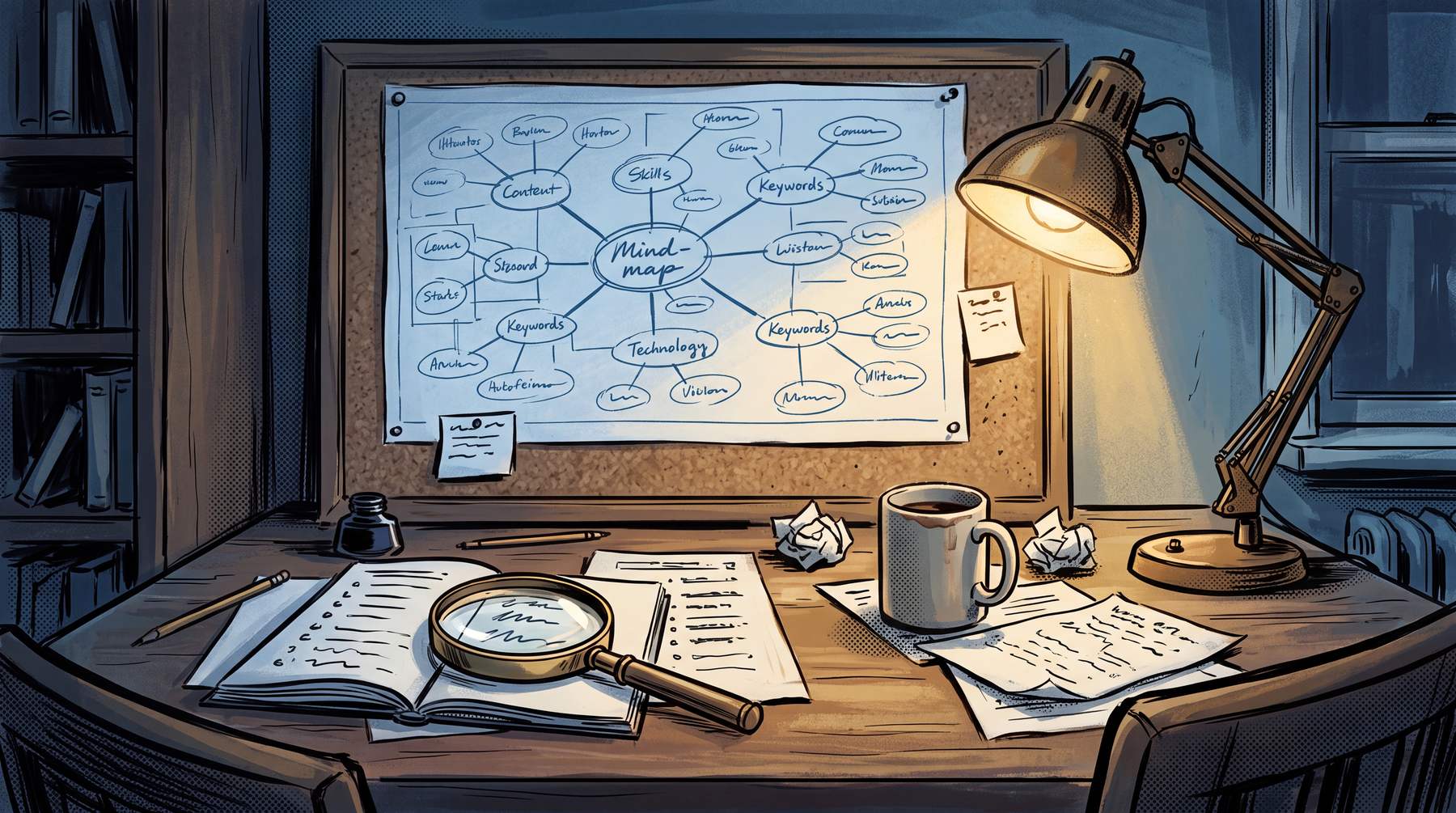
Keyword research should happen before the recording, not after it. Search engines work from the text layer around an episode, the page, title, description, transcript and show notes, so that is where the keyword work has to show up. If the keyword work happens only afterwards, the target terms sit in the metadata but not in the transcript, which is the densest part of the content. Building the keyword architecture into the research brief means the host speaks those terms naturally on the day.
The podcast SEO guidance I reviewed keeps coming back to the same advice: give search engines text. The episode page, the title, the description, the transcript, the show notes. One guide says it plainly, audio alone is difficult for search engines to interpret, and another says a transcript makes your content more crawlable. Two of them also point out that Google is working on understanding audio itself, and one quotes Google saying it already can in some languages, so read this as what works now and not as a promise that audio can never be read. Google's structured data documentation says it uses markup to understand the content of a page, and that adding it can enable richer search results. The safest bet today is a well-built text wrapper around the audio.
Given that, the usual workflow reads perfectly sensibly on paper. Record the episode, generate a transcript, then work the show notes, title and description over for the terms you want to rank for. What it does, though, is treat the transcript as raw material you can fit search intent onto afterwards, and the transcript is only ever a record of what the host knew and said when they sat down. Do the keyword research only after the recording and the terms you want end up living in your metadata, and not necessarily in the densest part of what you made, which is what the host actually said.
If you only do post-recording SEO, you often end up writing around a conversation that never targeted a real query in the first place.
What the research says about text versus audio
The current evidence supports transcripts and detailed episode pages being the main discoverability layer for podcasts in web search, because they are what exposes the words, entities and long-tail phrases inside an episode to a search engine. For open web visibility, meaning the kind that puts an episode in front of somebody typing into Google, the text wrapper is what matters. The guides I reviewed keep recommending versions of the same set: an episode page, a clear title, a detailed description, a transcript, show notes.
One honest caveat belongs here. Direct comparisons between pre-recording SEO and post-recording SEO in a podcast context do not appear to exist in the academic literature, at least not as of the research done for this article. The case for doing it beforehand is an inference from adjacent findings, and a strong one, but it is not a proven head-to-head result. What is well supported is that keyword density is not a direct ranking factor, and Semrush is explicit about that, and that topical completeness and natural language matter more than repeating a term mechanically.
I have not found controlled trials comparing episodes planned for SEO before recording against episodes optimised only after publication. What holds the pre-recording argument up is the production effect from memory research plus SEO fundamentals, and not a podcast-specific ranking comparison. I am stating what the evidence supports and nothing beyond it.
The speech and cognition angle
Memory research has a name for part of this: the production effect. Saying words aloud produces better later memory for them than reading them silently, a finding first delineated by MacLeod and colleagues in 2010 and replicated widely since. A concept a host has actually worked with in preparation is also easier to say naturally than a term they are trying to slot in on purpose, though that second part is inference from the first, not a separate finding. Put that against podcasting and it means a host who genuinely took a set of target terms on board during preparation is more likely to have them come out on their own across the recording. If those terms only exist in show notes bolted on afterwards, the transcript itself is thinner.
That difference is not a small one. What a transcript does best for search is carry natural, frequent use of the target language right across the running length, rather than a cluster of terms sitting in a show notes section the host never actually said out loud. A 45-minute episode with a full transcript is a lot of indexable text. Prepare that episode with a clear search intent and the relevant terms, entities and variations turn up in it on their own. Do not, and the terms end up in a thin layer of copy wrapped around a conversation that went somewhere else.
How I do it in practice
Before an episode goes into production I work out what someone would actually type to find it, and what they would type around it. That goes into the brief alongside the research findings. What the host gets is a document holding the verified claims, the shape of the argument, and inside that the language I want turning up naturally in the recording. Not a list of terms to insert anywhere. Part of how the argument is framed.
After the recording the transcript gets cleaned up as editorial content rather than left as raw machine output, so readable speaker labels, section breaks, a summary someone would actually use. The episode page gets built with the primary target in the title, a descriptive lead in the show notes, timestamps and structured data markup. Both phases are necessary and they are doing different jobs. The work before the recording decides what gets said. The work after it builds the page Google reads.
What this means for the transcript quality
There is a simple test for this. Read the transcript of an episode that was prepared with a clear search target next to one that wasn't. In the first the topic and the terminology around it turn up naturally the whole way through, because the host knew what they were talking about before they opened their mouth. In the second the topic is probably in the title and the show notes, while the transcript wanders and hedges and circles back, because the argument was never set. Post-production can clean the audio up. It cannot tighten reasoning that was never there.
What the current evidence supports best is planning the topic and the search intent before recording, speaking naturally to that intent, then publishing a strong text wrapper afterwards. Pre-recording and post-recording SEO were never competing approaches. They handle different parts of the same problem, and both are worth doing properly. The mistake is expecting the pass you do afterwards to make up for the work you skipped beforehand.