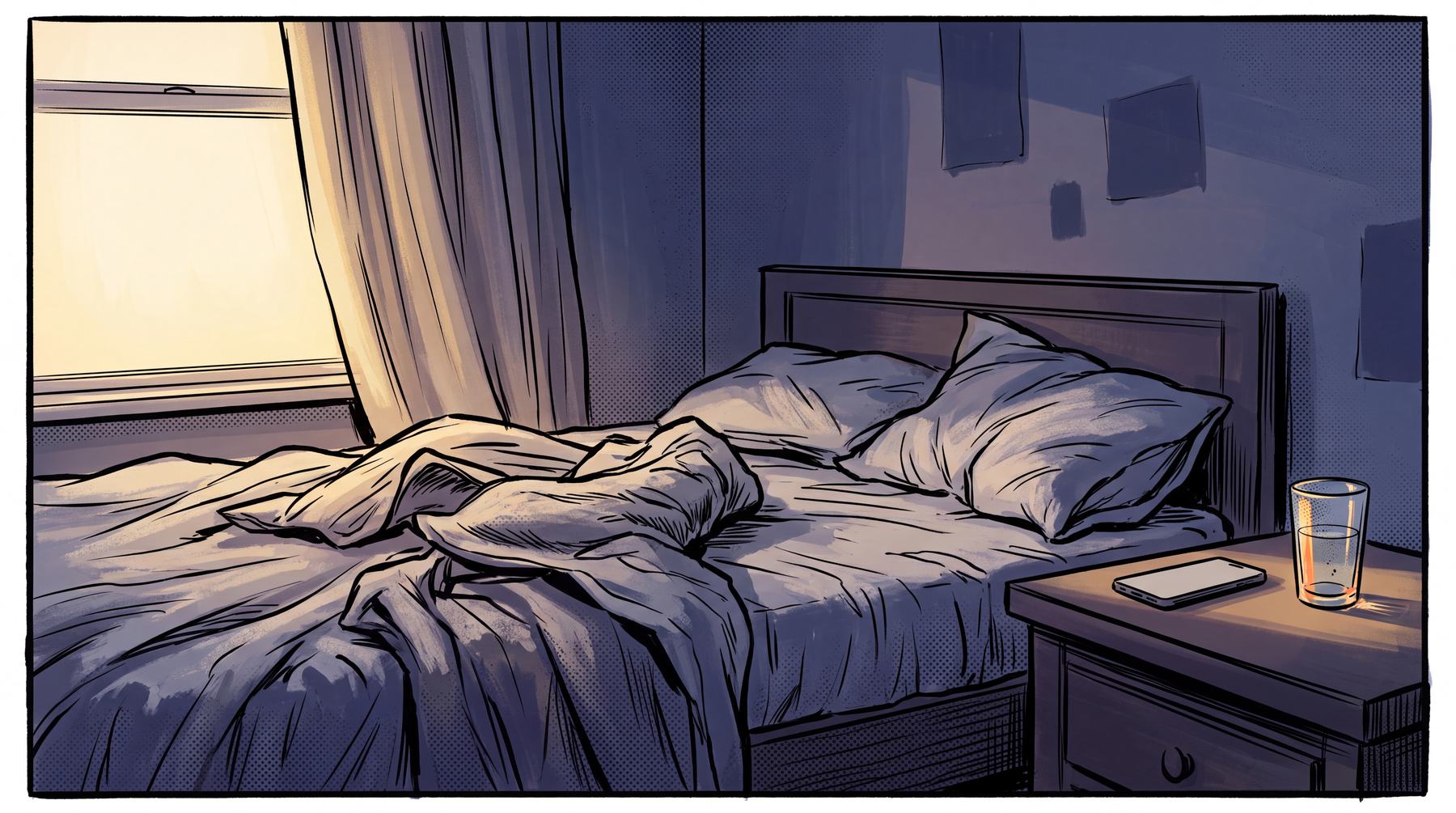
Episode 01 is about waking up already on edge, anxious before a single thought has arrived. The first hour after waking is a transition: the cortisol awakening response is part of normal waking, and sleep inertia means you're not at full performance yet. The episode looks at what gets piled on top of that, the phone first, time pressure, caffeine timing and training harder than your state allows, and at a minimum reset of around five to ten minutes that's small enough to survive a real morning. This is general education, not medical advice.
Amber Reed and Brian Hirst are two written characters, performed by AI voices. The research and the writing behind the episode are mine. How the show is made.
About this episode
Some mornings you're on edge before a single thought has arrived, and nothing is even wrong. Amber and Brian go through a nervous system friendly morning routine by looking at what reaches you first, more than at which habits you've got.
They go through the cortisol awakening response, which is part of how the body wakes up anyway, sleep inertia, and the four stackers that keep showing up: reactive information like messages and news straight away, time pressure, caffeine timing, and movement that's harder than your state can take that day. Then the floor: a minimum reset of five to ten minutes you can still do on a chaotic morning, and how to track one thing at a time without the tracking turning into another stressor. I keep my phone disconnected with notifications off in the mornings for exactly this reason, and on weak days I still reach for it too early.
One honest note: the time pressure, alarm, phone and movement points are how the hosts frame it in the episode, and I couldn't find a paper that tests them. The papers below are for the cortisol, sleep inertia, light, caffeine and breathing parts.
Chapters
- 00:00Opening
- 00:12Waking up already on edge the feeling that the day is already in you before anything happened.
- 01:03Doing everything right and still waking up wrong sleep, training and good habits, and the body still wakes up on alert.
- 01:42Why the first hour isn't neutral the morning as a window that reacts to what you put into it.
- 02:38The cortisol awakening response part of waking up, and the question of what you add on top.
- 03:14The pile-on phone, urgency, coffee and training, all before you're properly awake.
- 06:04Recovered or not why the same workout can steady you one day and flatten you the next.
- 07:14When mornings start in reaction mode other people's priorities taking your attention before you've arrived in the day.
- 09:47The four stress stackers reactive information, time pressure, caffeine timing and intensity mismatch.
- 16:15Anxious before anything happens the feeling can come first and the story second.
- 17:06The minimum viable reset a small floor routine built to survive bad mornings.
- 32:58Tracking without obsession one metric, one change at a time, on paper.
- 37:29The first 60 seconds what your body actually gets first, compared with what you intend.
What it covers
- A nervous system friendly morning routine, built around what happens first
- The cortisol awakening response, and why cortisol in the morning is normal
- Sleep inertia and the reduced performance right after waking
- Phone-first mornings and reactive information
- Time pressure and running late
- Caffeine timing as a personal test, moving the coffee later by about 20 minutes and noting how the morning feels
- Intensity mismatch: matching training to the state you're in that day
- Avoidable load against the load you can't change, like kids, shifts or a commute
- The minimum viable reset, around five to ten minutes
- Tracking one thing at a time, on paper, so the tracking doesn't wind you up too
The ideas in it
What reaches you first. The episode looks at the morning in order: what reaches you first, and what state you're in when it does. The same workout or the same coffee can feel fine one morning and rough the next, depending on what already hit you before it.
The cortisol awakening response. From what I read, in most healthy people cortisol goes up after waking anyway, it's part of getting up. So the episode looks at what you pile on top of it in that first hour.
Avoidable load. Some load you can't remove, and the episode doesn't pretend you can. The sorting question is what you're adding voluntarily that could wait an hour.
A small floor. A reset small enough to do on your worst morning: delay reactive information, and a few slow breaths with a longer exhale. You only scale it up if it stays easy.
Who it's for
- You wake up anxious or on edge and can't point at a reason.
- You're doing the healthy things and mornings still feel wrong.
- Your first move is the phone and you've started to notice what it does to the rest of the morning.
- You have kids, shifts or a commute that make a perfect routine impossible.
- You've tried big morning routines and dropped them within the week.
Resources and references
- Clow A, et al. "The cortisol awakening response: more than a measure of HPA axis function." Neuroscience & Biobehavioral Reviews, 2010. PubMed 20026350
- Stalder T, et al. "The Cortisol Awakening Response: Regulation and Functional Significance." Endocrine Reviews, 2025;46(1):43-59. PubMed 39177247
- Ogawa K, Kaizuma-Ueyama E, Hayashi M. "Effects of using a snooze alarm on sleep inertia after morning awakening." Journal of Physiological Anthropology, 2022;41:43. PMC9804954
- Duffy JF, Wright KP Jr. "Entrainment of the human circadian system by light." Journal of Biological Rhythms, 2005;20(4):326-338. PubMed 16077152
- Lovallo WR, et al. "Caffeine Stimulation of Cortisol Secretion Across the Waking Hours in Relation to Caffeine Intake Levels." Psychosomatic Medicine, 2005;67(5):734-739. PMC2257922
- Magnon V, Dutheil F, Vallet GT. "Benefits from one session of deep and slow breathing on vagal tone and anxiety in young and older adults." Scientific Reports, 2021;11. Scientific Reports article
- Giorgi F, Tedeschi R. "Breathe better, live better: the science of slow breathing and heart rate variability." Acta Neurologica Belgica, 2025;125(6):1497-1505. PubMed 40252198
- The time pressure, alarm, phone and movement points come from the hosts' own framing in the episode. None of the papers listed here tests them.
The written companion
The article that goes with this episode: Nervous System Friendly Morning Routine: Start Calm.
Search terms
- nervous system friendly morning routine
- waking up anxious
- morning anxiety
- morning routine science
- cortisol awakening response
- sleep inertia
- phone-first mornings
- caffeine timing
- minimum viable reset
This episode is general education, not medical advice. Severe or worsening symptoms warrant qualified support.