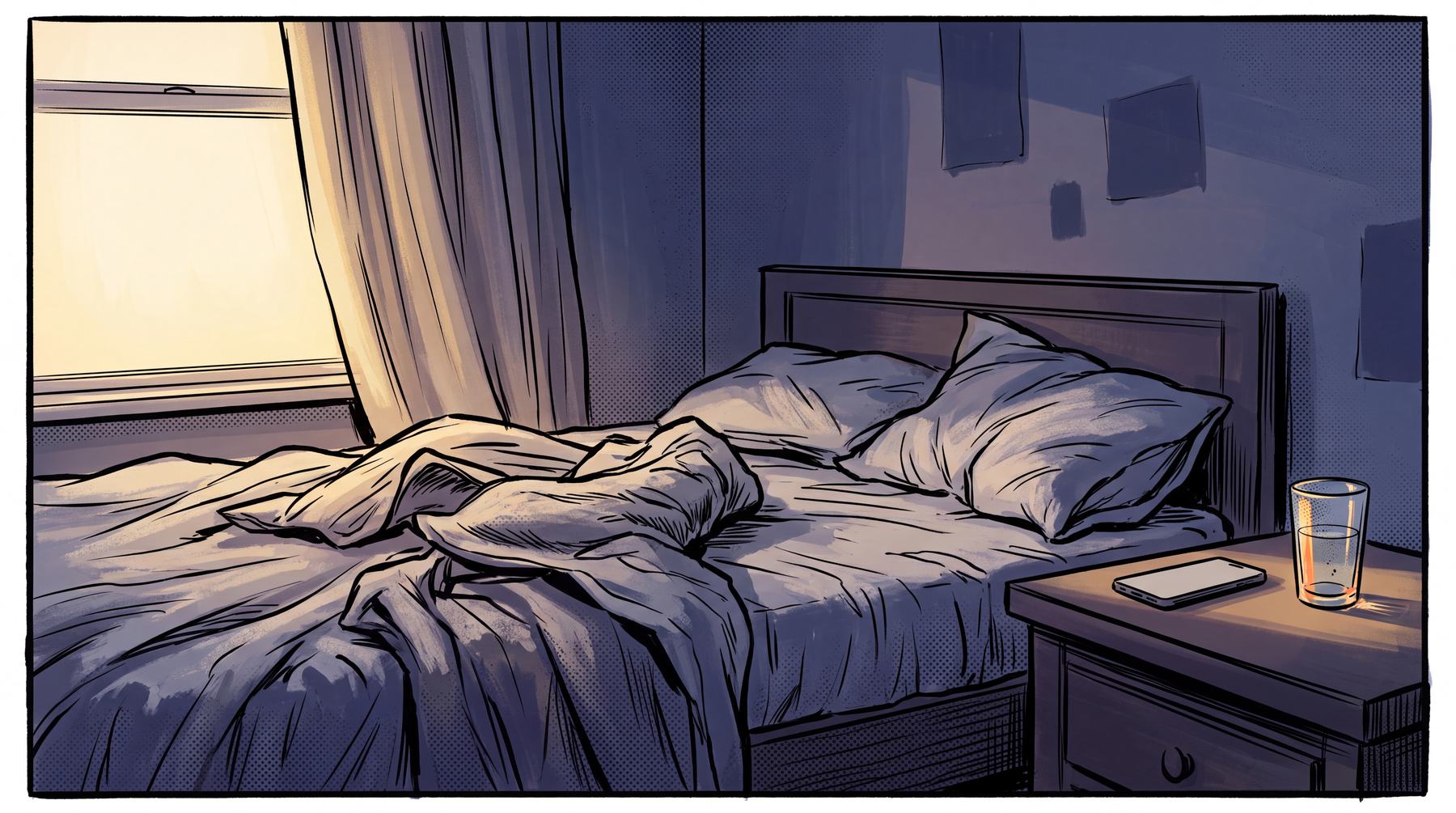
The first hour after waking is not neutral. The cortisol awakening response and sleep inertia change how everything feels, so the body can register activation before any thought explains it, and the mind then goes looking for a reason that seems solvable. A nervous-system-friendly morning routine treats that hour as a transition window rather than a productivity slot: fewer stress stackers, and a reset short enough to survive a real morning. This is general education, not medical advice.
If you've been searching for a nervous system friendly morning routine because you wake up anxious "for no reason," this episode of THE INSIGHT SOURCE offers a more useful frame than willpower or mindset: mornings are a cue-sensitive transition window, and what you stack on top of that window can amplify reactivity before a single thought arrives.
This is general education, not medical advice. If symptoms are severe, persistent, or worsening, seek qualified support.
In the episode, Amber Reed and Brian Hirst break down why the first hour "isn't neutral," how the cortisol awakening response and sleep inertia change how inputs land, and what to do when your day starts in reactive mode before you've even oriented to yourself.
What you'll learn:
- Why waking up can feel like an "alarm" before a single thought arrives.
- The most common morning stress stackers: reactive input, time pressure, caffeine timing, and intensity mismatch with movement.
- A minimum viable reset that's deliberately small, so it survives real mornings.
Prefer audio? Listen to the full episode.
Why you wake up anxious when nothing is wrong
One relieving idea in the episode is that sometimes the sensation comes first and the story comes second.
You wake up tight, and then your brain goes hunting for a reason you can "solve."
Amber describes this as waking up with the day already "in you", that tabs-already-open feeling, then trying to justify it by attaching it to a thought, an email, or a problem. Because a named problem feels controllable. A formless tightness doesn't.
In the Q&A, they answer the question directly: waking up is an activation event. Multiple systems ramp up, and if your baseline load is already high, that activation can feel like anxiety before any narrative appears.
If you wake up anxious, it's not automatically a sign that something in your life is wrong. Sometimes it is your system waking up loudly, and your mind adding the content afterwards.
The first hour isn't neutral: what's happening in your system
Amber's central point is simple: the first hour after waking is not a blank slate, and a nervous system friendly morning routine comes down to mechanics and sequencing rather than aesthetics.
Cortisol isn't the villain; the pile-on is
In the episode, Amber introduces the cortisol awakening response (CAR) and immediately steers away from the "cortisol panic" framing. Cortisol rises after waking as part of shifting from sleep physiology to awake physiology. It's fuel, not a threat.
The problem, as they frame it, is the pile-on rather than cortisol itself. Layering demand (phone, messages, news, coffee, hard training, rushing) on top of an already ramping system is what changes the texture of the morning. Common mistake to avoid: turning cortisol into a fear story, instead of noticing how stacking demand changes your experience of the first hour.
Sleep inertia: why your phone hijacks you more easily early
They also name sleep inertia, the groggy stretch just after waking, when you're less alert and your thinking and reactions are worse than usual.
Their point is that whatever you react to first sticks harder while you're still groggy. It's why "I'll just have a quick look" so easily becomes 20 minutes inside someone else's urgency.
The 4 morning stress stackers (and how they sneak in)
The episode keeps returning to one practical move: stop moralizing habits and start identifying the stack. Because timing and state matter more than the habit itself.
Amber names the four that come up most often: reactive input, time pressure, caffeine timing, and intensity mismatch with movement.
1. Reactive input (bigger than the phone)
They make a useful distinction: the phone is one path, but the deeper pattern is reactive input, which means handing your attention to external priorities before you have oriented to yourself.
The phone in the morning is a novelty-and-urgency machine. Even if nothing important is waiting, the design gives you something to react to. And that's the cost: not the content, but the handoff of attention before your baseline is set.
2. Time pressure (running late as a threat cue)
Time pressure looks like nothing and behaves like a threat. Amber's read is that running late works as a cue about being excluded, missing something, falling behind, and that the body hears it and prepares.
Add rushing to reactive input and you're in a compound state before you've brushed your teeth. They even name the alarm tone: their view is that a jarring alarm works like a startle, and for some people it sets the tone for hours.
Common mistake to avoid: treating rushing as purely a scheduling issue, instead of recognizing that it narrows perceived choice and amplifies reactivity.
3. Caffeine timing (coffee as data, not tribal identity)
They treat coffee with respect. The question is what happens when you stack caffeine on an already activated wake-up window, not whether coffee is good or bad.
For some people, coffee immediately feels grounding. For others, it amplifies the edge. In a controlled study, caffeine raised cortisol, and the response was smaller in people who drank it every day, so your own habit matters. Not wrong, but worth testing.
Amber's suggestion: delay it by 20 minutes. Not as a moral challenge, but as data.
4. Intensity mismatch (state-based dosing for movement)
This is the one that collides with identity. Hard movement is a stressor, a useful one, but if your system is already carrying a lot, adding a large sympathetic spike can make you feel brittle rather than regulated.
The core principle: state-based dosing. The same workout is not the same stimulus when one person is recovered and another is under-slept or carrying heavier load. Brian describes learning this the hard way, chasing hard sessions because they were the only thing that quieted his head, then realizing when they stopped working that he'd lost his only regulator.
Replace the function, not just the habit.
The minimum viable reset (5–10 minutes that survives real life)
A nervous system friendly morning routine doesn't have to be long. The "minimum viable reset" in the episode is intentionally boring, because if it is exciting it is probably too complicated.
Amber's floor is three things:
- Delay reactive input for about 10 minutes. Not forever. The phone stays where it is long enough to interrupt the automatic reach.
- A few slow exhales, longer out than in. Not breathwork. Not a challenge. Just giving the body a direction.
- Daylight early. Window, balcony, outside. Keep it simple. Light is the dominant environmental cue that sets the human body clock, and Amber's point is that you don't need a special lamp.
I went looking for something behind the slow exhales, and there is some. In one study, 47 adults did a single session of slow breathing with a longer breath out than in. Afterwards a heart rate variability number tied to vagal tone was higher, and they felt less anxious right then. A 2025 review pulled together six studies in healthy adults, and every one showed better heart rate variability, with the clearest gains where the breathing stressed longer breaths out. The review says the protocols still need standardising.
They add one important guardrail: if breathing makes you dizzy, stop immediately. Simplify or skip it. The goal is reducing load, not adding a new stressor.
Key takeaway: small actions matter more in sensitive windows, because your system is already ramping up. That's what a sensitive window is.
How to personalize: state-based dosing + real constraints
A recurring theme is constraint-respect. Amber calls out kids, commutes, shift work and real inflexibility directly. This is not about blaming people for having a life.
If you can't delay your phone (on-call, work constraints), they suggest changing how you enter it: check one channel for urgent messages, close it, stand before you check. Small design moves that stop you falling into infinite scroll.
For parents: reduce optional load the night before (prep one thing, simplify breakfast, put clothes out). Not to become optimized, but to buy the nervous system two minutes of not being chased.
What to change first: one subtraction, one support
To keep this from becoming another performance project, Amber keeps it to one thing.
Remove one stacker. Not because it's evil, but because you need contrast to feel what actually matters. Adding without subtracting just creates noise, and turns the morning into another job.
Then add one support: slow exhales, daylight, water.
Track one metric for a week. Morning anxiety 0–10. Time until you feel steady. Whether you got daylight. On paper if possible, because turning tracking into an app creates a new reason to pick up the phone.
If your routine keeps getting longer and your life isn't getting better, it's probably not a habit deficit. It's a load problem. The morning can stop you from making the load worse. It can't make an impossible life possible.
Build a floor, not a fantasy
A nervous system friendly morning routine works best when it's built for real mornings, not ideal ones.
The first hour isn't neutral. Stacking demand early can amplify reactivity. Reactive input, time pressure, caffeine timing and intensity mismatch are common stackers worth testing, one at a time.
The minimum viable reset (delay input, slow exhales, daylight) is small on purpose. So it stays stable when life doesn't.