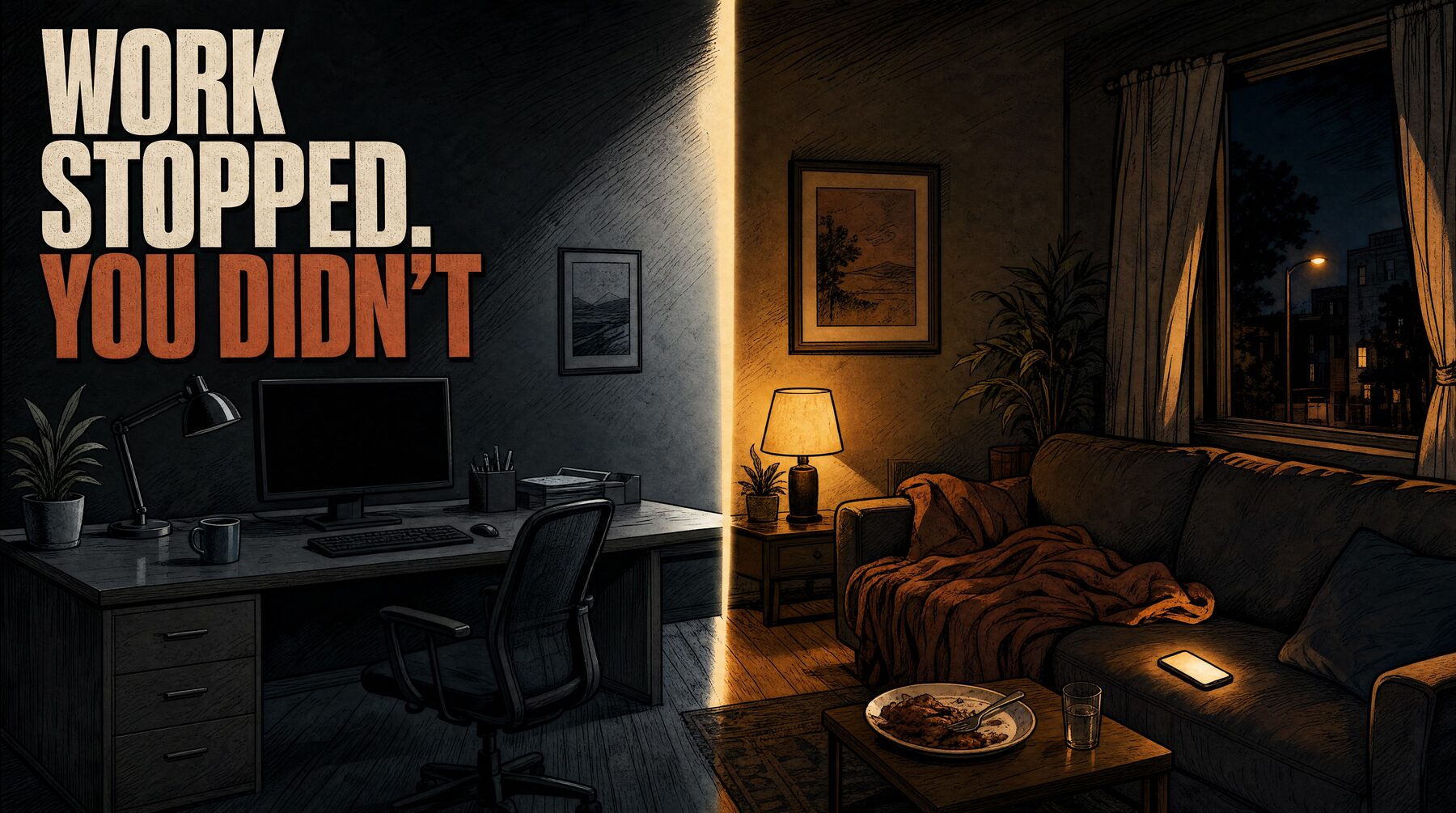
Episode 03 is about the tired you can't explain. Work is fine on paper, you slept, and you still wake up behind. The episode looks at burnout recovery from the side most advice skips, the costs outside the job that keep pulling from the same account: sleep, money worry, close relationships, information all day, caregiving. It goes through why time off and recovery are two different things, a plain test for whether your rest does anything, and three small things to start with, beginning with a week of just looking. This is general education, not medical advice.
Amber Reed and Brian Hirst are two written characters, performed by AI voices. The research and the writing behind the episode are mine. How the show is made.
About this episode
Work's fine, you slept, and you still wake up feeling behind before the day has started. This episode is for anyone who's tired in a way they can't explain, and it looks at burnout recovery from the side most advice skips: the costs outside the job that keep pulling from the same account.
So the episode goes through why time off and actually recovering aren't the same thing at all, why the official burnout definition leaves a lot of people without even a name for it, and a pretty simple test for whether your rest does anything. I researched this one partly because I reach for my phone and call it a break more often than I'd like.
You come away with three small things to start this week, beginning with a week of looking before you change anything. Anything severe or getting worse belongs with a professional.
Chapters
- 00:00The tired you can't explain why a reasonable week and a full night's sleep can still leave you behind on Monday.
- 01:42Invisible energy leaks the background costs that never show up in the workload conversation.
- 02:16What the burnout definition leaves out the World Health Organization calls burnout an occupational phenomenon, and what that means if your job is fine.
- 05:04What drains you outside of work sleep, money worry, close relationships, information all day, caregiving and the effort of showing up for people.
- 06:59When you blame yourself for being tired the "I shouldn't be this tired" verdict and the question it blocks.
- 07:41Time off versus recovery why not working and actually recovering are two different states.
- 09:17The after test for your rest judging rest by how you feel after, and what to do on days when scrolling is all you can manage.
- 10:55Signs burnout recovery is working what changes over a couple of weeks when rest starts doing its job.
- 12:23Burnout recovery starts with a map rating your energy four times a day for a week and noting what came before each drop.
- 13:58The pre-sleep hour and slow breathing one quiet hour with notifications off and a few minutes of breathing every day, small enough to do on a bad day.
- 15:45Burnout recovery with no day off what the starting point looks like for a parent with no structural break.
- 17:14When meditation makes it worse why a practice that triggers panic is information, and what to try instead.
- 18:23When to get professional support the signals that mean stop self-experimenting.
- 19:05The one thing to start with why the map comes before anything else.
What it covers
- Burnout recovery when your job isn't the problem
- Why you can be tired even after sleeping
- Time off versus recovery, and rest that doesn't restore
- Invisible energy leaks across sleep, money, relationships and screens
- The World Health Organization's work-only burnout definition
- The after test for whether rest is doing anything
- The seven-day energy map
- A protected pre-sleep hour and slow breathing with a longer exhale
- Starting points for parents and for people who can't relax
The ideas in it
Total stress load. From what I read, the stress from work and the stress from everything else come out of the same capacity. The episode puts it as a budget: people cut the one big cost they can see, and the eight or ten small ones keep taking from the same account.
The official definition. The World Health Organization's ICD-11 describes burn-out as an occupational phenomenon and says it shouldn't be applied to other areas of life. The episode doesn't argue with the classification. It looks at what it leaves out for people whose exhaustion runs off the rest of their life.
Time off versus recovery. Time off just means you're not at work. From what I read, recovering needs a stretch where repair can happen, and that means not much new coming at you. A typical evening off, laptop shut and phone straight out, stays busy.
The after test. You check how an hour left you. If you come out of it flatter, more wired or a bit hollow, it didn't do much, wherever you spent it. And if a show is the only thing you can manage, that tells you how depleted you are; the test only asks what it produced.
Three starters before any framework. The energy map, one protected pre-sleep hour with notifications off, and five to ten minutes of slow breathing with a longer exhale, no breath holds. If an hour without a screen is impossible, 20 minutes is the starting point, and that counts as doing it properly. If a calming practice keeps triggering anxiety, scale down and try something with attention going outward, like a walk without audio or cooking without a screen.
Who it's for
- You're tired on your days off and can't point at a reason, because work is fine on paper.
- You took the break, booked the holiday, cut back, and a week later it was gone again.
- Your evenings off are mostly phone, chats and a show, and you've started to suspect that's not rest.
- You're a parent or carer without a real day off and every recovery plan assumes time you don't have.
- You tried meditation or relaxation apps and they made you feel worse.
- You keep telling yourself you shouldn't be this tired.
Resources and references
- World Health Organization (28 May 2019). Burn-out an "occupational phenomenon": International Classification of Diseases. WHO news release
- Mental Health UK (January 2025). The Burnout Report 2025. YouGov survey of 4,418 UK adults; things outside work that caused high or extreme stress include poor sleep, money worries, personal relationships, caring and parenting responsibilities. The Burnout Report 2025 (PDF)
- de Bloom J, Kompier M, Geurts S, de Weerth C, Taris T, Sonnentag S. "Do we recover from vacation? Meta-analysis of vacation effects on health and well-being." Journal of Occupational Health, 2009;51(1):13-25. PubMed 19096200
- Westman M, Etzion D. "The impact of vacation and job stress on burnout and absenteeism." Psychology & Health, 2001;16(5):595-606. PubMed 22804501
- Hjetland GJ, Skogen JC, Hysing M, Gradisar M, Sivertsen B. "How and when screens are used: comparing different screen activities and sleep in Norwegian university students." Frontiers in Psychiatry, 2025;16:1548273. PubMed 40270574
- DataReportal (2025). Digital 2025: Global Overview Report. The average internet user spends about 6 hours 38 minutes online a day. DataReportal report
- Cleveland Clinic (23 December 2025). "How To Reset Your Vagus Nerve Naturally." Practical guide; recommends an exhale longer than the inhale. Cleveland Clinic article
From Anja
My wife Anja works on burnout recovery from the gut and nervous system side, and went through burnout herself. Her article on bringing the gut-brain axis back into balance treats sleep, nervous system regulation, time in nature and gut work as one connected picture. It's in German, and a browser translation works pretty well. More of her work at Anjas Weg.
The written companion
The article that goes with this episode: Why Am I So Tired on My Days Off? The Costs Outside Work.
Search terms
- burnout recovery
- burnout when your job isn't that hard
- why am I tired even after sleeping
- why am I so tired on my days off
- rest that doesn't restore
- invisible energy leaks
- time off vs recovery
- energy map
- chronic exhaustion
This episode is health education, not medical advice. If you have thoughts of self-harm, worsening depression or serious physical symptoms, please get professional support.