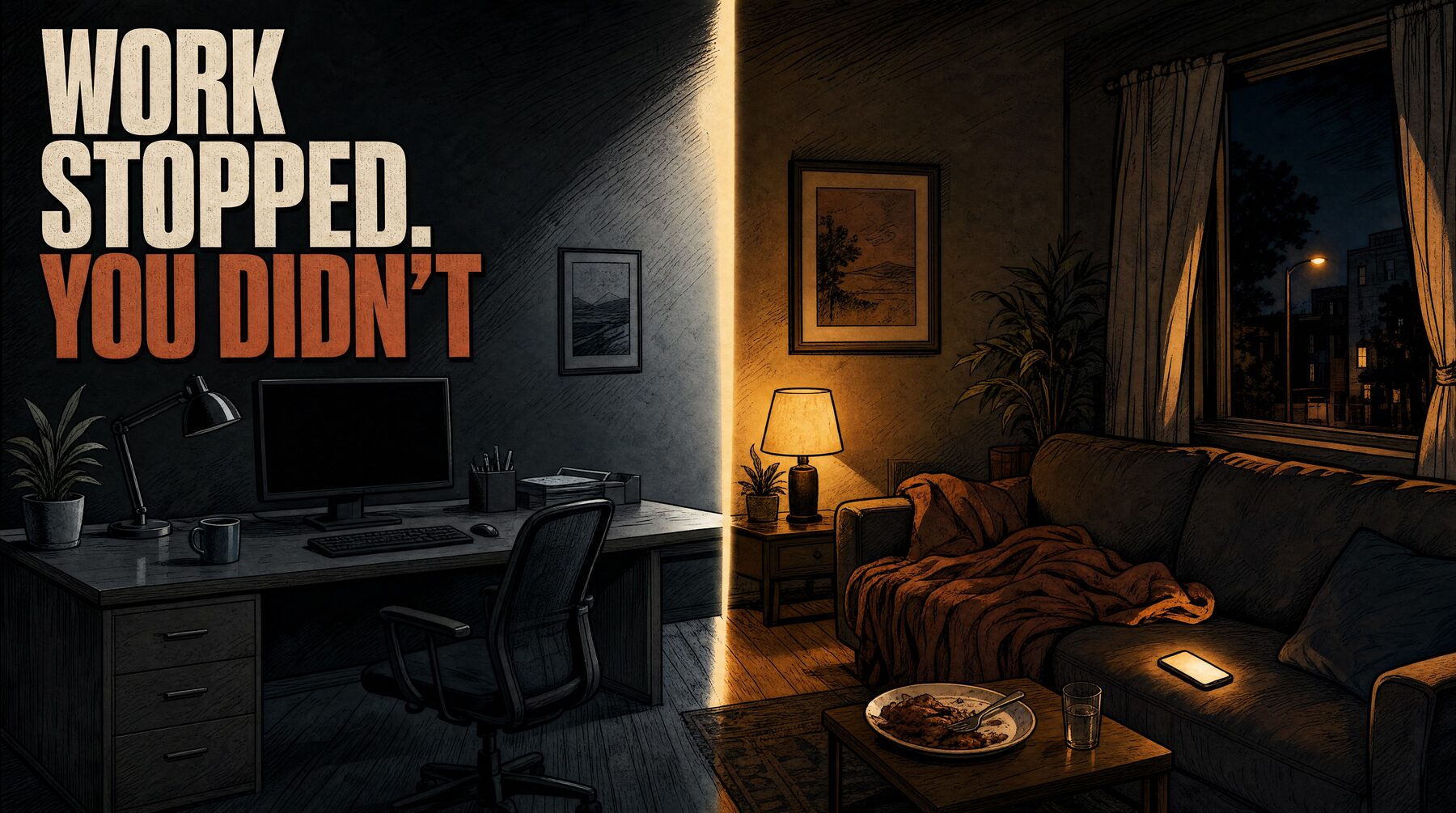
Being tired on your days off when work is fine usually means the costs outside the job are still running: sleep, money worry, relationships, information all day, caregiving. Time off and recovery are different things, so judge your rest by how you feel after, and start with a week of mapping your energy before changing anything.
Just to start with, I am not claiming I had a burnout or anything close to that, my affiliation with it is purely based on outside experience and research since my wife went through it and I started to sense what this actually means and what people actually have to deal with. … So here we go.
So you had a reasonable week, nothing blew up, work is fine on paper, you slept properly on Saturday, and you still wake up feeling wrecked or behind before the day has even started. If you've ever typed "why am I so tired on my days off" into a search bar, this one's for you, cos burnout recovery for a lot of people starts somewhere the usual advice never looks, which is outside the job.
And you've heard the advice. Take a break, book a holiday, cut back a bit. Most people in that spot already tried some version of it, and a week later it was gone again and they were back in that hole.
Here's what this goes through: what drains you outside of work, why time off and actually recovering are two different things, a pretty simple test for whether your rest does anything, and three small things to start with this week. It follows the episode and the research behind it. This is, as always, educational, not medical advice.
Prefer to listen? Watch or listen to the full episode.
What does the official burnout definition actually say?
The World Health Organization's ICD-11 describes burn-out as an occupational phenomenon, the result of chronic workplace stress that hasn't been successfully managed, and it says pretty explicitly that the term refers to the occupational context and shouldn't be used for experiences in other areas of life. It also isn't classified as a medical condition there.
The episode doesn't call the definition wrong, it does its job, but if you're the person from the top, tired with the job fine, it kind of works against you. If burnout is officially a work thing and your work is fine, whatever you've got has no name and no plan, so you just live with it.
I hold the word itself to a high bar. The wellness crowd throws it at a rough week like it's the flu and a relaxing weekend sorts it out, and honestly that annoys the hell out of me, more than it probably should. I never had burnout myself. My wife Anja did, starting in 2020, and years later she still lives with what it left behind, so when people use the word for a bad week it grates on me a bit.
So still, please don't decide it doesn't count just because it isn't technically burnout by the definition of the WHO, cos then you're back to living with it and not looking at it.
So what's draining you outside of work?
The episode calls them invisible energy leaks, the stuff running in the background that never shows up in your job description or in the workload conversation, but pulls from the same account the whole time. And the list is pretty ordinary, which is part of why nobody counts it. Bad sleep. Money worry, which runs in the background all the time and doesn't care that it's Saturday. Whatever's going on with the people closest to you, good or bad. The amount of stuff you take in all day, messages, news, feeds, one after the other. Looking after kids or parents, and the effort of just showing up properly for people when you've got nothing left.
The way the episode puts it is a budget, deposits and withdrawals. Most people find the biggest withdrawal they can see, which is usually work, and cut that one, and only that one. But if you've got eight or ten small costs running all the time that you're not even registering, the account stays overdrawn anyway.
For me a big one is the way we live. We've been on the road since 2021 without a home base, and the constant searching for the next place, the landlord stuff, noise, mold, bad sleep in bad beds, and never really feeling like you've arrived anywhere, none of that shows up on any work list. I'd never call it burnout, it just adds up over the years, and after all this time it's honestly enough now.
And then there's the shame bit, which makes all of it worse. Your job is fine, you're exhausted, you can't explain it, so the verdict comes in, I shouldn't be this tired, other people have harder lives, what's wrong with me. That loop blocks the only useful question, which is what's actually costing you energy that you haven't been counting yet.
Why doesn't time off fix it?
What I only really got while researching this one is how much keeps going out even when you're off, and how far apart time off and recovery actually are. Time off just means you're not at work. Recovery is a state where repair can actually happen, and from what I read and honestly also feel, that needs a stretch where not much new is coming at you. And it's where you experience reloading, through moments of awe and wonder and calm, and calm can't be overstated here.
So what does time off usually look like? You close the laptop and the phone comes out, you're scrolling, you're in three group chats, there's a notification about the thing you were anxious about yesterday, then a show. Every new thing takes a little, not a lot, but something, and the rest you were going for never really starts.
I'm guilty of this one, a lot. I reach for the phone and call it a break, but we all know it wasn't one. Researching this episode pulled it up close again, how much of my own time off is just the phone with distractions from a different seat. I even try to keep the phone disconnected, with notifications turned off, in the evenings and in the mornings so it's not pulling on me with novelty, and still, on the weak days I'm on it way too late or early and I know it while I'm doing it.
The episode calls that rest that doesn't restore. Booking more time off doesn't change much if the mornings & evenings stay like that.
How do you know if burnout recovery is actually working?
There's a test in the episode I really like, cos it's so plain: judge your rest by what you feel like after, not by what you did. If an hour leaves you more present and more settled and more able to function the next day, it did something, keep it. If you come out of it flatter, or more wired, or kind of hollow, it wasn't recovery, wherever you spent it, desk or couch.
To be fair to the scrolling though, the finger-wagging about screens doesn't help anyone who's running on empty. Distraction has a place, and if one more episode of something on the sofa at nine at night is genuinely all you can manage, that tells you something about how empty the tank is, and the test is only about what it did for you afterwards.
And what would tell you it's working? It's pretty boring stuff, and slow, a couple of weeks rather than days: sleep that gets a bit better, morning energy that's more consistent from one day to the next, and being more there during the day instead of wired or flat. Most don't post about that stuff, which is probably why it's easy to miss when it starts happening. If those signs aren't showing up, your rest is probably still too busy.
If this is sounding familiar and you wanna hear more, the full episode goes through it with more examples.
What to do first when you're exhausted all the time
The episode says it pretty openly, a recovery framework handed to someone who's already running on empty mostly feels like more stuff to add to a full life, so it starts with three small things for this week instead.
The first one is a seven-day energy map. You rate your energy from 0 to 10 four times a day, morning, midday, afternoon and evening, and when it drops by two or more you circle it and write down what happened in the two or three hours before. That's it, just looking, no fixing yet.
Then the evening phone thing from earlier, turned around: one hour before sleep with all notifications off and nothing new coming in, and the episode says seven days of it, so you get to see whether anything shifts instead of judging it after one night. The closest I've got to that myself is the phone on red-only from bedtime and the Endel and Portal sounds I've used at night for a long time now to fall asleep and to gently wake up, which isn't instead of anything, for me it's just easing into the calm in the morning and evening.
And five to ten minutes of slow breathing a day, with the exhale a bit longer than the inhale, checked with the same after test as everything else. The episode keeps it gentle on purpose, comfortable, no breath holds, especially if those make you more anxious, and you scale it down whenever you need to, cos five minutes every day does more than one long session once a week. With my brain, which goes looking for the next thing the second there's a gap, even five minutes sounds like a lot, so I get why it starts that small.
None of this has to be the full version on day one. For a parent with structurally no day off, where every evening ends with the kids and then the phone in bed, the episode's starting point is 20 minutes before sleep without the phone.
And if you're drawn to whatever sounds most powerful, the episode's point is to pick the thing you'd still manage on a bad day instead.
When is this a job for a professional?
Some signals mean you stop experimenting on yourself and get professional support: thoughts of self-harm, hopelessness or depression that's getting worse instead of better, serious physical warning signs, or a regulation practice that keeps triggering panic or dissociation. Please take that one seriously, a podcast and a blog post can only go so far.
Start with the map
If you saw yourself anywhere in here, the short version is: what drains you outside of work counts even when work is fine, an evening on the phone is still busy, and the place to start is the map, a week of just looking before you change anything. A lot of people already have a pretty good idea which leak they'd cut first, they just haven't written it down yet.
If you read German, Anja's article on bringing the gut-brain axis back into balance takes the gut and nervous system side, sleep, regulation, time in nature, as one connected picture (a browser translation works pretty well).
Next step today, start the map. Four numbers a day, for a week.
Listen to the full episode. Follow THE INSIGHT SOURCE so you catch the next one, and if someone you know is tired on their days off and can't say why, send this to them.