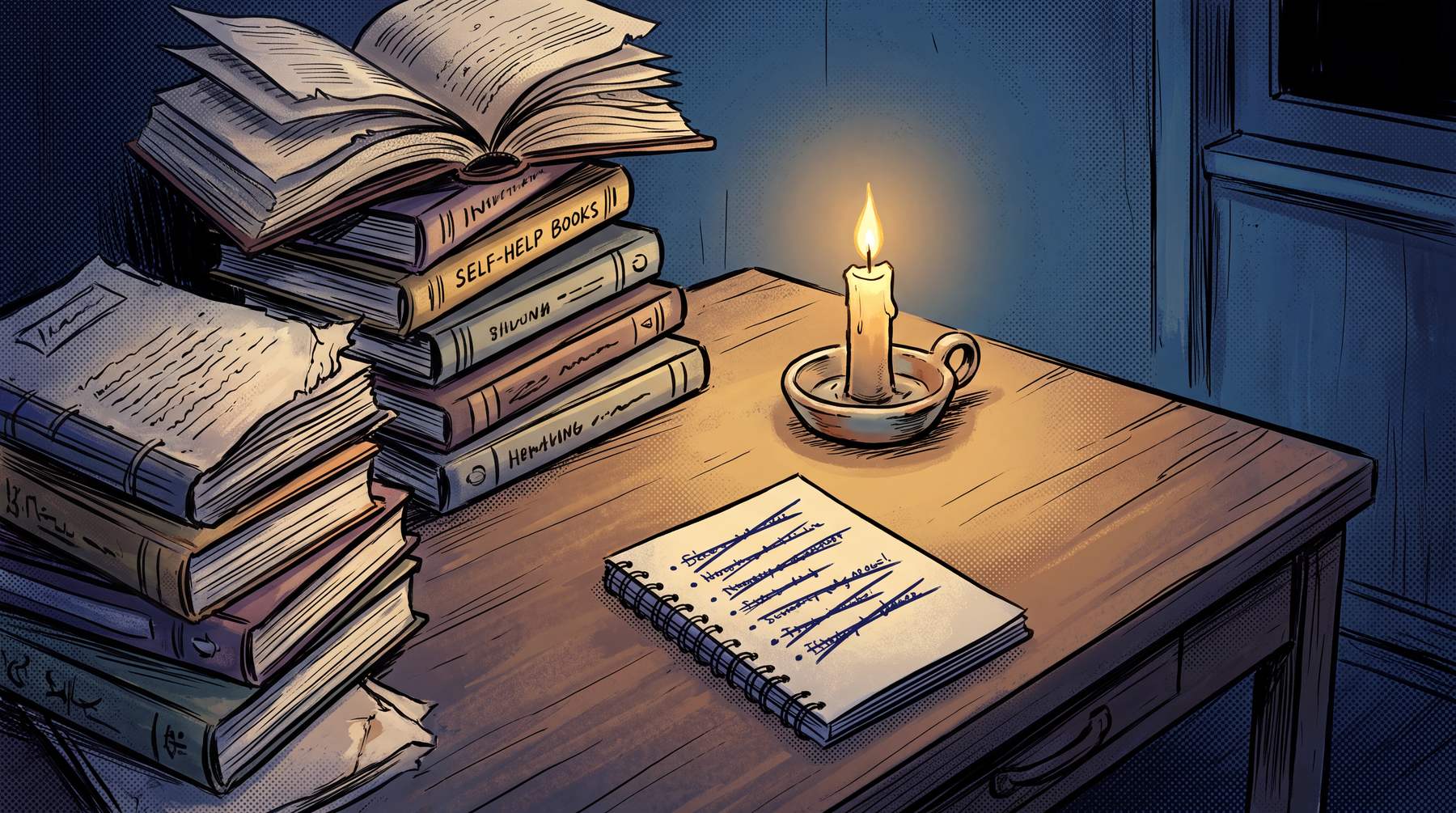
Self-improvement burnout is what happens when the list looks right and you feel worse anyway. Therapy, journaling, training, sleep tracking. Nothing on it is obviously wrong, which is exactly what makes it confusing. The practices are rarely the problem. What the routine is organised around usually is. A practice held in place by anxiety about not being enough carries a different cost than the same practice held in place by interest. This is general education, not medical advice.
I'll say it upfront, I don't love the word burnout. The wellness crowd throws it at a rough week and acts like a spa weekend sorts it out. So I hold it to a higher bar than that. But there's a real version of self-improvement burnout, and it's a sneaky one, cos from the outside it looks like you're doing everything right.
Therapy. Journaling every morning. Training. Tracking your sleep. The whole list. Nothing on it is obviously wrong. And then a few months in you don't feel the same, you feel worse. That's the part nobody warns you about, and it's the part that messes with your head.
This is, as always, educational and not medical advice. If something's been dragging on for a long time or it feels serious, get real support, not a podcast.
Quick honesty before we go further, this one is close to home. My brain is wired for new and more. Fifty unfinished things at any time, and I start them faster than I integrate them. So when I say I know this pattern, I mean I'm in it, not above it.
Here's what you'll get out of this: why the practices themselves are almost never the problem, the quiet switch that turns a good habit into something that drains you, the 15-minute move that shows you what to pause, and why calm starting to feel suspicious is information, not weakness.
Prefer to listen? Full episode here.
Why Self-Improvement Burnout Feels So Confusing
Picture someone genuinely trying. Good habits across the board, real effort, no obvious mistake anywhere. And a few months later they're in a worse spot than when they started. The first instinct, every single time, is that something on the list must be wrong, or that they're not doing enough of it. And it's almost never that.
The confusing bit is that it really does look like the work is happening. Because it is. Something about how it's happening is just working against itself. When a practice stops paying off, the obvious move is "wrong tool, or not enough of it," so off you go to find another one. The answer always feels like more, or something new.
That's the trap I keep falling into. New habit, new system, one more course, the missing piece. What I'm calling growth is often just novelty dressed up as self-improvement. And it's a default reaction, not some character flaw. It just happens to make the load heavier every time.
So the mistake isn't the habits. It's reading the list as the problem and quitting the lot. The practices are usually fine. What's driving them is the thing to look at, and how many you've got running at once.
The Real Driver: Fear vs Care
At some point, and this happens quietly, nobody actually decides it, you stop doing things because they help you and start doing them because you're scared of what happens if you stop.
That's the difference between a care-driven practice and a fear-driven one, and it's the real engine underneath self-improvement burnout.
To be fair, starting from fear is completely fine. That's how most change begins. Something feels off, you get worried, you go find something that helps. The problem is when it keeps running long after the thing has stopped helping. Now you're not doing it because you feel better after. You're doing it because not doing it feels like a threat.
And there's a second cost. Walk into a practice already carrying that weight, and the time off can't do what it would do without the pressure sitting behind it. Worse, you start running an internal audit on yourself, scoring whether you did it "right" instead of noticing whether it actually helped. Track a calm practice with an app, rate every session, and you've turned a break into a performance review. You just built more of the problem into the solution.
Self-Compassion Is A Performance Input, Not Softness
Here's the one that goes against the grain. Being hard on yourself feels like the thing that separates the people who improve from the people who don't. And in the right conditions, high stakes, short term, clear goal, it does work. The trouble is what self-criticism does over time. It runs you on an alarm state, motivating for short bursts, but eventually you start playing not to lose. You stop trying things that might fail, because failing under that kind of internal pressure costs too much. You're still grinding. Nothing scares you anymore, and nothing moves either.
In four experiments, people who were led to treat a failure with self-compassion were more motivated to improve than people who got a self-esteem exercise, a distraction or nothing. It didn't pit self-compassion against self-criticism, but it doesn't support the idea that being kind to yourself makes you softer. Not softer. Stronger.
And self-compassion here isn't the cheerful version. "Be kinder to yourself" is useless advice. It's more that when the voice shows up, the one going you should be further along by now, everyone else figured this out, you talk to it the way you'd talk to someone you respect who's having a hard time. Honest, not cruel, not fake-positive. Something like, this is genuinely hard, and here's what's actually true right now.
So the hard part was never being nicer to yourself. It's being accurate. Which is harder than beating yourself up and harder than faking positivity, because both of those let you skip looking at what's actually true.
The Fix Starts With Subtraction: The 15-Minute List
The fix almost always starts by taking something away, not adding something. Which is annoying, cos the whole instinct when something isn't working is to go find a better version of it.
So here's the move. Write down everything you currently do to work on yourself or take care of yourself. All of it. Then, honestly, next to each one, write how you feel after doing it most of the time. Better, the same, or worse. It's not fancy. Takes about 15 minutes, and many people have never actually sat down and done it.
Then the ones where the honest answer is "worse" most of the time, you pause those. Not forever. A week or two, just to see what happens. Even the technically healthy ones, because something you're doing out of fear of stopping isn't the same as something that's helping you, even when they look identical from the outside.
The trick that makes it survivable, you don't delete anything. You park the paused ones on a "Later, Maybe" list. Your brain doesn't read it as a permanent loss as long as it still exists somewhere. You're not rewriting who you are. You're just not doing this one thing for a couple of weeks. And keep one small thing that genuinely helps, something calm that doesn't turn into another streak you have to maintain.
This is roughly how I do it for myself now, by the way. Before anything new goes on my list, I try to ask first what from the current list actually held this week. I'm not perfect at it. But it's the right question.
When Rest Starts To Feel Suspicious
Go hard for long enough and calm itself starts to feel suspicious. Like something's wrong if you're not still doing something. You sit down and within seconds there's this pull to get back up and be useful.
That feeling is worth paying attention to. If genuine rest reads as a threat, that's information about what's actually running your show, not a flaw to push through. It's also how you tell real help apart from "I did something healthy." You feel different after. Not "I completed something." Just quieter. It sounds vague on purpose, because the marker is your internal state, not a box you ticked.
Make It Real: One Boundary That Costs The Least
Here's where it gets real or it doesn't. You can do all the honest inner work, and then Monday arrives and nothing about your actual week has changed, and within about three days you're right back where you started. If the conditions don't change, there's a ceiling on what the inner shift can do for you.
So you need specific limits you actually set for yourself, without turning them into another task list. Not "I'll try to do less," which does nothing. Something like "no emails after a certain time," and you mean it. One thing you can point at and say, that's where it stops.
And limits carry real costs, relationships, work, money, so you don't start with the bravest one. You start with the one that costs the least, the smallest limit that still gives you a bit of relief. The first one is mostly about proving to yourself that nothing falls apart when you hold a line. Once you've got that evidence, the next one is easier. And if someone pushes, "I can't take that on right now" is a complete sentence. You don't owe an explanation, cos the second you start explaining, the whole thing's up for negotiation again.
The One Thing To Take Away
If you saw yourself anywhere in this, here's the short version.
Self-improvement burnout is almost never about the practices. It's about what's driving them, and how many you're running at once. The move is subtraction first, write the list, pause what leaves you worse, keep one small thing. And one real boundary is what makes the inner work actually stick once normal life starts up again.
Many people already know which thing they'd pause. They've known for a while. They just haven't let themselves stop. If that's you, take this as the permission.
I'll add the part that's closest to home. My wife Anja spent years recovering from burnout, and being that close to it, then digging into the research for this episode, showed me a smaller version of the same pattern running in my own life without me seeing it clearly. The drive to improve had quietly become the thing draining me. That's a quantity issue. And you can't fix a quantity issue by adding more.
Next step today, write the list. Fifteen minutes. Everything you do to work on yourself, and an honest better, same, or worse next to each one. That's where it starts.